
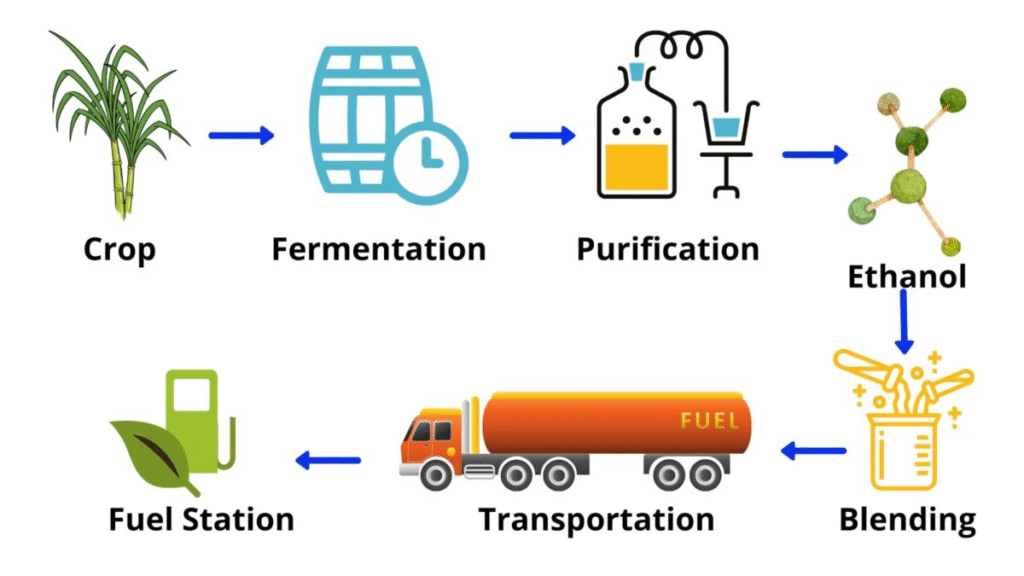
People in India are dying of hunger, and now the government seems to be taking even that away — all in the name of ethanol blending.
And for what? To benefit the two sons of a Union Minister who are allegedly involved in the ethanol business — putting the entire nation at stake for personal gain.
Can any sensible, educated person truly accept this?
But wait — let’s uncover the real truth behind ethanol blending, without politics, without bias — only with pure facts, data, and knowledge.
So watch till the end.
What is Ethanol?
Ethanol is a biofuel — a type of fuel made from plant materials that contain sugar or starch.
Chemical Formula – C₂H₆O or C₂H₅OH
What is Ethanol Blending?
Ethanol blending means mixing ethanol with petrol.
For example:
- E5 = 5% ethanol
- E10 = 10% ethanol
- E20 = 20% ethanol
India actually started ethanol blending back in 2003, so this isn’t a new concept.
The latest target was to achieve E20 blending by 2030, but the goal was met five years early — in 2025.
Now, the government aims to increase blending further and promote second-generation ethanol.
What is Second-Generation Ethanol?
Until now, ethanol has been produced from corn and sugarcane, which can affect food supply.
But second-generation ethanol will be made from agricultural waste and non-edible materials, which do not interfere with food crops.
The Major Concern
People are worried that most vehicles currently on the road in India are not designed to handle higher concentrations of ethanol.
This could lead to reduced vehicle life and lower fuel efficiency.
So why is the government still moving ahead with it?
The Real Impact on Vehicles
Older, non-reliable vehicles may see just a 1–2% drop in fuel efficiency — which is very minimal.
A vehicle’s average lifespan is 10–12 years, and so far, there’s no concrete data showing a drastic reduction in life span.
Some reports do suggest that vehicles may experience wear and tear more frequently, which means more frequent servicing may be needed.
Food Supply and Crop Diversion Concerns
Ethanol production from sugarcane or maize increases sugar prices and diverts land that could be used for food crops.
However, with secondary and tertiary ethanol, production will shift to agricultural waste and surplus, not food crops.
But here’s the question — if India faces hunger and food shortage, where will this “surplus” come from?
The truth is — India produces plenty of crops, but due to poor storage and distribution systems, food doesn’t reach people and ends up spoiling.
So yes, the system is flawed, but this clarifies one thing:
Ethanol blending has nothing to do with worsening food shortages.
Will Vehicle Life Actually Reduce?
There’s no concrete evidence yet that vehicles will have a shorter lifespan.
Yes, due to slightly more frequent wear and tear, the lifespan may reduce by 2–3 years, but that’s manageable.
Why This Step Still Makes Sense
Despite these small drawbacks, this move is absolutely necessary right now.
Every year, lakhs of people in India die due to pollution.
Many Indian cities rank among the most polluted in the world, and India is among the top five most polluted countries globally.
Pollution today is nothing short of a public health crisis.
We can’t shut down factories overnight — though efforts are being made to shift them to renewable energy.
So, we too need to do our part.
That’s why I believe the government’s move is right.
Yes, there will be some inconvenience — but pollution is far more dangerous.
And let’s be honest — people who can’t afford car servicing usually don’t own cars in the first place.
Those who do, can afford it.
So no, this isn’t a disaster — it’s simply a step toward a cleaner, healthier, and better future.

waahhh